
Food & Florals: A Love Story
Food and florals exist within the same condition—both cultivated, arranged, and temporary, with much of their beauty tied to timing, handling, and the brief period before they begin changing shape entirely.
Recently, I’ve been drawn to arrangements where ingredients are treated with the same consideration usually reserved for florals, where fruit becomes vessel, herbs extend beyond the edge of a composition, and vegetables are handled less like produce and more like sculptural material.
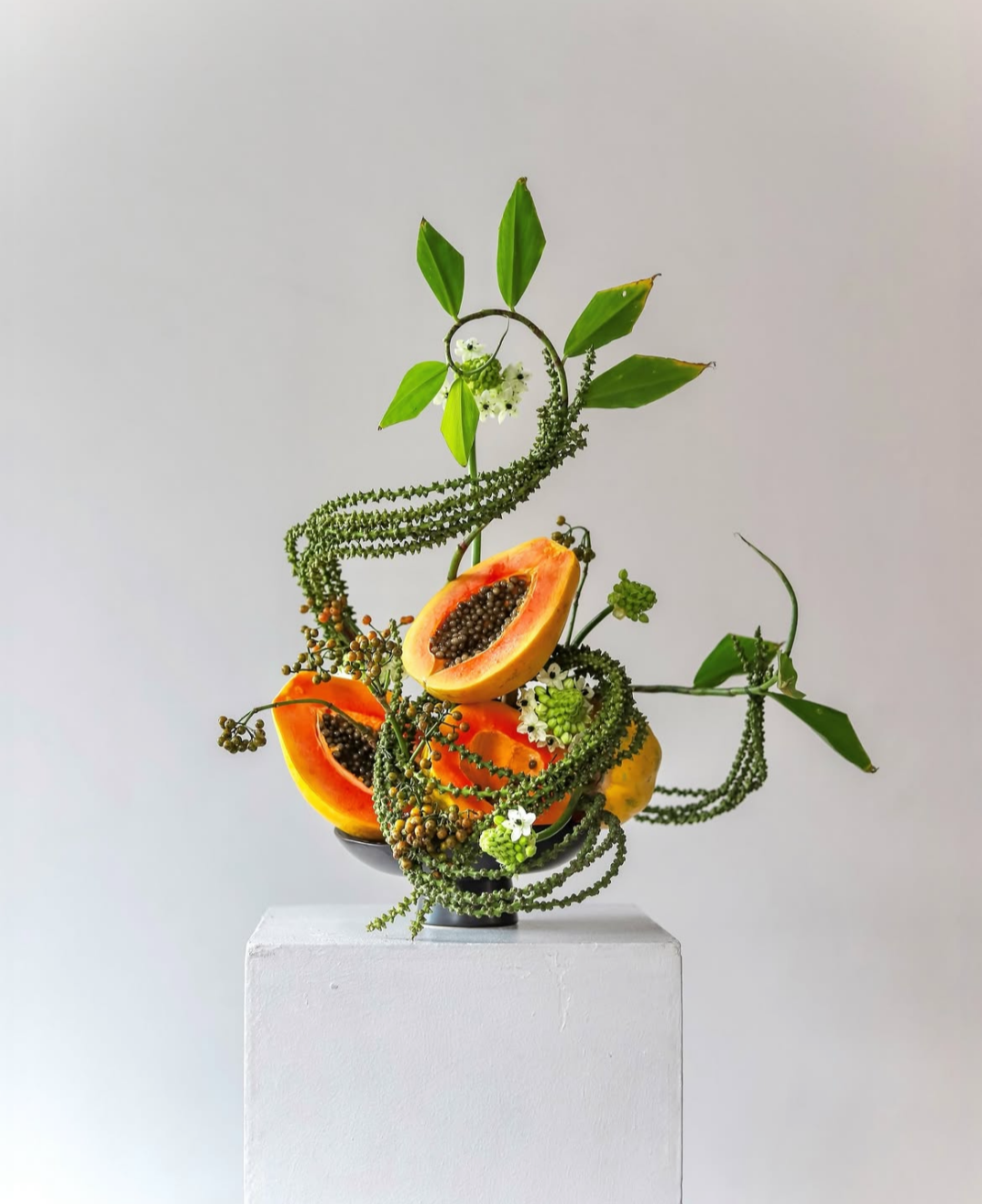
In @gracejolie_kr’s arrangement, papaya is suspended among cascading greens with such balance that it stops reading as fruit entirely. The composition feels architectural without becoming rigid, using the weight, curve, and color of the papaya almost the same way a florist might use oversized blooms. What makes the piece especially compelling is its restraint. Nothing feels forced or overly styled, even though every element is clearly considered.
At @kol.restaurant, the tulip is treated as both ingredient and presentation. The flower itself is grown without pesticides so the petals can be eaten safely, while the center is removed and replaced with a beetroot and pear sorbet tinted a deep pink-red reminiscent of cactus fruit. A touch of mezcal and chili shifts the flavor away from sweetness alone, and the tulip is flash-frozen with liquid nitrogen so the petals remain crisp while the inside stays soft. The result feels less like dessert and more like a study in texture and fragility.
@vanelja’s flower chips transform rice paper into delicate edible petals by layering turmeric-colored rice between cut sheets before frying them briefly in oil. Once expanded, the forms resemble flowers more than chips, somewhere between snack and sculpture, with the translucency of the rice paper giving them an almost fabric-like quality.
At @grazed_za, dip is spread across a canvas and layered with herbs and edible flowers so the entire surface becomes interactive and temporary. Crackers are dragged directly across the composition to eat it, slowly disrupting the arrangement as guests engage with it. The piece works because it accepts destruction as part of the design rather than something that ruins it.
Several of the works from @heylee.blooms approach floristry through food waste and overlooked materials. In one arrangement, kiwi skins are toothpicked together and used as small vessels for flowers, with the fruit itself saved rather than discarded. No floral foam or glue is used, allowing the arrangement to remain temporary and biodegradable. In another, broccoli stalks become floral bases, while Brussels sprout leaves are peeled back into flower-like forms and attached to old stems, blurring the distinction between vegetable and bloom almost completely.
At @foodmymuse, shaved brie and petite basque cheese are layered around a butter-filled center until the surface resembles soft petals unfolding outward. The final piece sits somewhere between cheese board and floral centerpiece, meant to be cut into and spread apart, changing shape as it’s eaten.
@soberishmom’s pear glass crisps are made from thin pear slices coated in sugar syrup and layered with edible flowers before drying into translucent sheets. The finished pieces catch light almost like stained glass, preserving the delicate structure of the flowers inside the pear itself.
At @mustloveherbs, caprese ingredients are transformed into miniature mushrooms using mozzarella, tomato, basil, and small piped dots of cream cheese. Styled together on greenery, the pieces resemble tiny forest growths more than appetizers, playful without losing their attention to detail.
The final installation by @jackkinsey expands the idea into an entire environment. A lemon branch is suspended above a dining table with lemons hung individually from its limbs, while hollowed lemon peels are transformed into floating candles placed along the center of a water-filled vessel. The arrangement feels less like tablescape styling and more like temporary set design, immersive in a way that still retains simplicity.
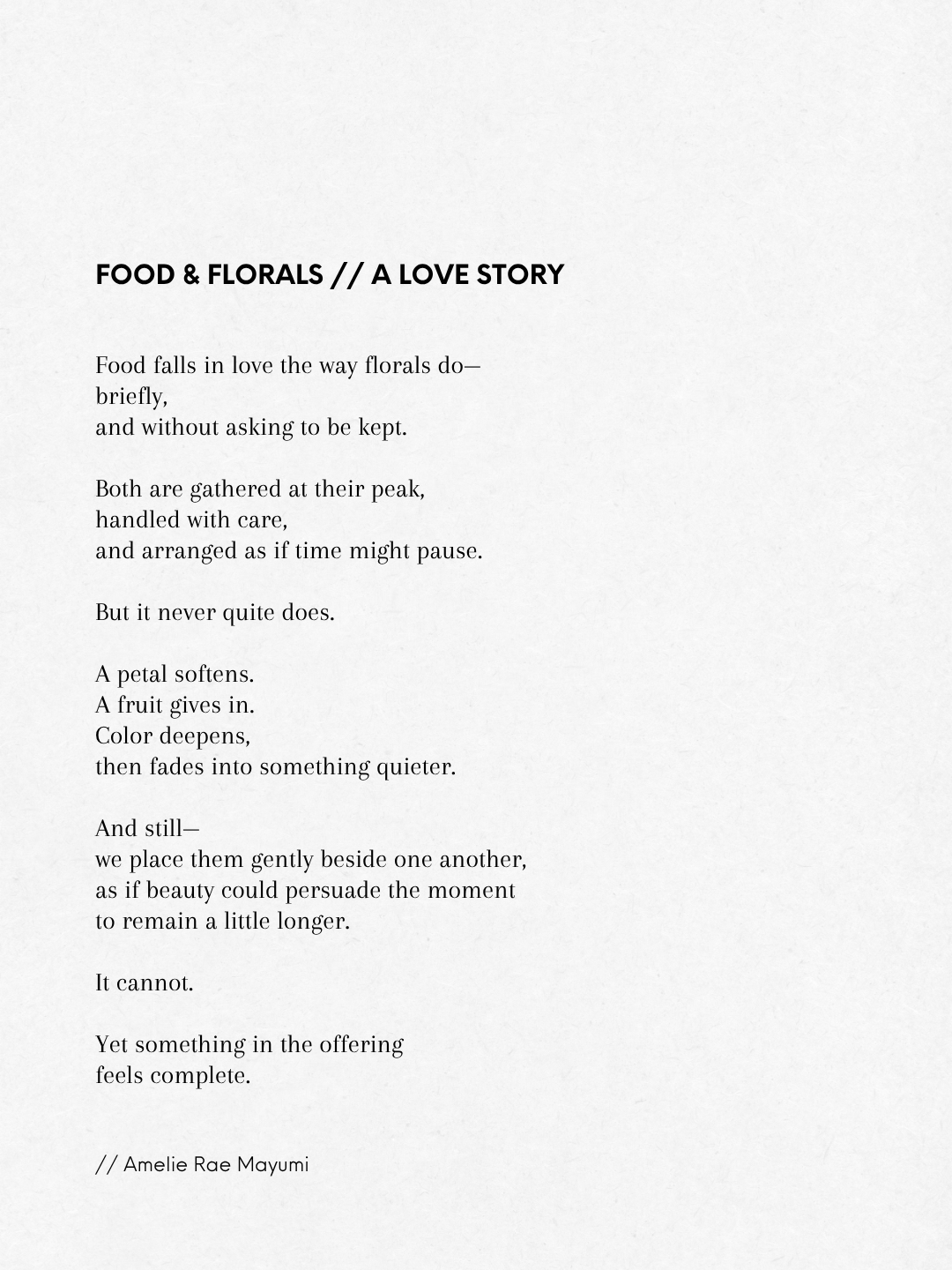
What connects all of these works is not decoration alone, but a shared acceptance of impermanence. Flowers wilt. Fruit oxidizes. Herbs curl inward overnight. Cheese softens. Citrus dries at the edges. None of the arrangements attempt to resist that process. Instead, they seem built around it, allowing the materials to remain visibly alive, fragile, and temporary from beginning to end.